Showing posts with label Cardiomyopathy. Show all posts

Tuesday, September 6, 2022

Drosophila used to help understand the role of Filamin in cardiomyopathies

Biol Open. 2022 Sep 6:bio.059376. doi: 10.1242/bio.059376.

Drosophila CRISPR/Cas9 mutants as tools to analyse cardiac filamin function and pathogenicity of human FLNC variants.

Ader F, Russi M, Tixier-Cardoso L, Jullian E, Martin E, Richard P, Villard E, Monnier V

Abstract: Filamins are large proteins with actin binding properties. Mutations in FLNC, one of the three filamin genes in humans, have recently been implicated in dominant cardiomyopathies, but the underlying mechanisms are not well understood. Here, we aimed to use Drosophila melanogaster as a new in vivo model to study these diseases. First, we show that adult-specific cardiac RNAi-induced depletion of Drosophila Filamin (dFil) induced cardiac dilatation, impaired systolic function and sarcomeric alterations, highlighting its requirement for cardiac function and maintenance of sarcomere integrity in the adult stage. Next, we introduced in the cheerio gene, using CRISPR/Cas9 gene editing, three missense variants, previously identified in patients with hypertrophic cardiomyopathy. Flies carrying these variants did not exhibit cardiac defects or increased propensity to form filamin aggregates, arguing against their pathogenicity. Finally, we show that deletions of the C-term part of dFil carrying the last four Ig-like domains are dispensable for cardiac function. Collectively, these results highlight the relevance of this model to explore the cardiac function of filamins and increase our understanding of physio-pathological mechanisms involved in FLNC-related cardiomyopathies.

DOI: 10.1242/bio.059376
PMID: 36066120

Wednesday, April 14, 2021

Drosophila studies help in characterization of disease-associated variants in ATAD3A

Genome Med. 2021 Apr 12;13(1):55. doi: 10.1186/s13073-021-00873-3.

Functional interpretation of ATAD3A variants in neuro-mitochondrial phenotypes.

Yap ZY, Park YH, Wortmann SB, Gunning AC, Ezer S, Lee S, Duraine L, Wilichowski E, Wilson K, Mayr JA, Wagner M, Li H, Kini U, Black ED, Monaghan KG, Lupski JR, Ellard S, Westphal DS, Harel T, Yoon WH


From the abstract:

ATPase family AAA-domain containing protein 3A (ATAD3A) is a nuclear-encoded mitochondrial membrane-anchored protein involved in diverse processes including mitochondrial dynamics, mitochondrial DNA organization, and cholesterol metabolism. Biallelic deletions (null), recessive missense variants (hypomorph), and heterozygous missense variants or duplications (antimorph) in
ATAD3A lead to neurological syndromes in humans. ... To expand the mutational spectrum of ATAD3A variants and to provide functional interpretation of missense alleles in trans to deletion alleles, we
performed exome sequencing ... in ATAD3A in individuals with neurological and mitochondrial phenotypes. A Drosophila Atad3a Gal4 knockin-null allele was generated using CRISPR-Cas9 genome editing technology to aid the interpretation of variants. ... We report 13 individuals from 8 unrelated families with biallelic ATAD3A variants. ... Affected individuals exhibited findings previously associated with ATAD3A pathogenic variation ... Drosophila studies indicated that Phe50Leu, Gly236Val, Arg327Pro, and Lys568del are severe loss-of-function alleles ... Leu77Val and Arg170Trp
are partial loss-of-function alleles that cause progressive locomotion defects ... Our findings expand the allelic spectrum of ATAD3A variants and exemplify the use of a functional assay in Drosophila to aid variant interpretation.

DOI: 10.1186/s13073-021-00873-3
PMID: 33845882

Monday, April 22, 2019

Models and methods -- fly research related to heart disease

Bell KM, Kronert WA, Huang A, Bernstein SI, Swank DM. The R249Q hypertrophic cardiomyopathy myosin mutation decreases contractility in Drosophila by impeding force production. J Physiol. 2019 Apr 4. doi: 10.1113/JP277333. PMID: 30950055.

From the abstract: "... Hypertrophic cardiomyopathy (HCM) is a genetic disease that causes thickening of the heart's ventricular walls and is a leading cause of sudden cardiac death. HCM is caused by missense mutations in muscle proteins including myosin ... We investigated the disease mechanism for HCM myosin mutation R249Q by expressing it in the indirect flight muscle of Drosophila melanogaster and measuring alterations to muscle and flight performance. Muscle mechanical analysis revealed R249Q decreased muscle power production due to slower muscle kinetics and decreased force production; force production was reduced because fewer mutant myosin cross-bridges were bound simultaneously to actin. ... Overall, our results do not support the increased contractility hypothesis. Instead, our results suggest the ventricular hypertrophy for human R249Q mutation is a compensatory response to decreases in heart muscle power output."

Lee CY, Wang HJ, Jhang JD, Cho IC. Automated drosophila heartbeat counting based on image segmentation technique on optical coherence tomography. Sci Rep. 2019 Apr 3;9(1):5557. PMID: 30944361; PMCID: PMC6447591.

From the abstract: "... studies on drosophila cardiac have improved our understanding of human cardiovascular disease. Drosophila cardiac consist of five circular chambers: a conical chamber (CC) and four ostia sections (O1-O4). ... An automated drosophila heartbeat counting algorithm based on the chamber segmentation is developed for OCT in this study. This algorithm has two parts: automated chamber segmentation and heartbeat counting. In addition, this study proposes a principal components analysis (PCA)-based supervised learning method for training the chamber contours to make chamber segmentation more accurate. ... The average calculated heart rates of two-week and six-week drosophila were about 4.77 beats/s and 4.73 beats/s, respectively, which was consistent with the results of manual counting."

Thursday, May 17, 2018

Fly studies help shed light on contribution of KAT2B variants to ADD3-associated disorders

Gonçalves S, Patat J, Guida MC, Lachaussée N, Arrondel C, Helmstädter M, Boyer O, Gribouval O, Gubler MC, Mollet G, Rio M, Charbit M, Bole-Feysot C, Nitschke P, Huber TB, Wheeler PG, Haynes D, Juusola J, Billette de Villemeur T, Nava C, Afenjar A, Keren B, Bodmer R, Antignac C, Simons M. A homozygous KAT2B variant modulates the clinical phenotype of ADD3 deficiency in humans and flies. PLoS Genet. 2018 May 16;14(5):e1007386. PMID: 29768408.

The abstract: "Recent evidence suggests that the presence of more than one pathogenic mutation in a single patient is more common than previously anticipated. One of the challenges hereby is to dissect the contribution of each gene mutation, for which animal models such as Drosophila can provide a valuable aid. Here, we identified three families with mutations in ADD3, encoding for adducin-γ, with intellectual disability, microcephaly, cataracts and skeletal defects. In one of the families with additional cardiomyopathy and steroid-resistant nephrotic syndrome (SRNS), we found a homozygous variant in KAT2B, encoding the lysine acetyltransferase 2B, with impact on KAT2B protein levels in patient fibroblasts, suggesting that this second mutation might contribute to the increased disease spectrum. In order to define the contribution of ADD3 and KAT2B mutations for the patient phenotype, we performed functional experiments in the Drosophila model. We found that both mutations were unable to fully rescue the viability of the respective null mutants of the Drosophila homologs, hts and Gcn5, suggesting that they are indeed pathogenic in flies. While the KAT2B/Gcn5 mutation additionally showed a significantly reduced ability to rescue morphological and functional defects of cardiomyocytes and nephrocytes (podocyte-like cells), this was not the case for the ADD3 mutant rescue. Yet, the simultaneous knockdown of KAT2B and ADD3 synergistically impaired kidney and heart function in flies as well as the adhesion and migration capacity of cultured human podocytes, indicating that mutations in both genes may be required for the full clinical manifestation. Altogether, our studies describe the expansion of the phenotypic spectrum in ADD3 deficiency associated with a homozygous likely pathogenic KAT2B variant and thereby identify KAT2B as a susceptibility gene for kidney and heart disease in ADD3-associated disorders."

Monday, September 28, 2015

Mitochondrial disease and the heart explored in fly study

Martínez-Morentin L, Martínez L, Piloto S, Yang H, Schon EA, Garesse R, Bodmer R, Ocorr K, Cervera M, Arredondo JJ. Cardiac deficiency of single cytochrome oxidase assembly factor scox induces p53-dependent apoptosis in a Drosophila cardiomyopathy model. Hum Mol Genet. 2015 Jul 1;24(13):3608-22. PMID: 25792727; PMCID: PMC4459388.

From the abstract: “... most patients with mitochondrial disease produced by defects in the oxidative phosphorylation (OXPHOS) system are susceptible to cardiac involvement. ... but the molecular mechanisms involved in cardiac impairment are unknown. One of the most frequent OXPHOS defects in humans frequently associated with cardiomyopathy is cytochrome c oxidase (COX) deficiency caused by mutations in COX assembly factors such as Sco1 and Sco2. ... we have heart specifically interfered scox expression, the single Drosophila Sco orthologue. Cardiac-specific knockdown of scox reduces fly lifespan, and it severely compromises heart function and structure, producing dilated cardiomyopathy. ... Genetic and molecular evidence strongly suggest that dp53 is directly involved in the development of the cardiomyopathy induced by scox deficiency. Remarkably, apoptosis is enhanced in the muscle and liver of Sco2 knock-out mice, clearly suggesting that cell death is a key feature of the COX deficiencies produced by mutations in Sco genes in humans.”

Monday, March 23, 2015

Fly model links mitochondrial function, cell death and heart disease

Martínez-Morentin L, Martínez L, Piloto S, Yang H, Schon EA, Garesse R, Bodmer R, Ocorr K, Cervera M, Arredondo JJ. Cardiac Deficiency of Single Cytochrome Oxidase Assembly Factor scox Induces p53 Dependent Apoptosis in a Drosophila Cardiomyopathy Model. Hum Mol Genet. 2015 Mar 19. pii: ddv106. PMID: 25792727.

From the abstract: "... most patients with mitochondrial disease produced by defects in the Oxidative Phosphorylation System (OXPHOS) are susceptible to cardiac involvement. ... One of the most frequent OXPHOS defect in humans frequently associated with cardiomyopathy is cytochrome c oxidase (COX) deficiency caused by mutations in COX assembly factors like Sco1 and Sco2. ... we have heart specifically interfered scox, the single Drosophila Sco orthologue. Cardiac-specific knockdown of scox reduces fly lifespan, and it severely compromises heart function and structure, producing dilated cardiomyopathy. ... Genetic and molecular evidence strongly suggests that dp53 is directly involved in the development of the cardiomyopathy induced by scox deficiency. Remarkably, apoptosis is enhanced in the muscle and liver of Sco2 knock-out mice, clearly suggesting that cell death is a key feature of the COX deficiencies produced by mutations in Sco genes in humans."

Monday, February 23, 2015

Review suggests "fully integrative" approach using mulitple models including Drosophila to understand cardiomyopathies

Duncker DJ, Bakkers J, Brundel BJ, Robbins J, Tardiff JC, Carrier L. Animal and in silico models for the study of sarcomeric cardiomyopathies. Cardiovasc Res. 2015 Jan 18. pii: cvv006. PMID: 25600962.

From the abstract: "Over the past decade, our understanding of cardiomyopathies has improved dramatically, due to improvements in screening and detection of gene defects in the human genome as well as a variety of novel animal models (mouse, zebrafish, and drosophila) and in silico computational models. These novel experimental tools have created a platform that is highly complementary to the naturally occurring cardiomyopathies in cats and dogs that had been available for some time. A fully integrative approach, which incorporates all these modalities, is likely required for significant steps forward in understanding the molecular underpinnings and pathogenesis of cardiomyopathies. ..."

Figure 2 of the review summarizes types of heart-related studies that can be done using Drosophila.

Tuesday, August 26, 2014

Fly model of cardiomyopathy--role for galactokinase

Lee TE, Yu L, Wolf MJ, Rockman HA. Galactokinase Is a Novel Modifier of Calcineurin-Induced Cardiomyopathy in Drosophila. Genetics. 2014 Jul 31. PMID: 25081566.

From the abstract: "Activated/uninhibited calcineurin is both necessary and sufficient to induce cardiac hypertrophy, a condition that often leads to dilated cardiomyopathy, heart failure, and sudden cardiac death. We expressed constitutively active calcineurin in the adult heart of Drosophila melanogaster and identified enlarged cardiac chamber dimensions and reduced cardiac contractility. In addition, expressing constitutively active calcineurin in the fly heart using the Gal4/UAS system induced an increase in heart wall thickness. We performed a targeted genetic screen for modifiers of calcineurin-induced cardiac enlargement ... we generated a model for discovering novel modifiers of calcineurin-induced cardiac enlargement in the fly and identified galactokinase as a previously unknown regulator of calcineurin-induced cardiomyopathy in adult Drosophila."

Tuesday, August 5, 2014

Fly model of calcineurin-induced cardiac hypertrophy uncovers role for galactokinase

Lee TE, Yu L, Wolf MJ, Rockman HA. Galactokinase Is a Novel Modifier of Calcineurin-Induced Cardiomyopathy in Drosophila. Genetics. 2014 Jul 31. PMID: 25081566.

From the abstract: "Activated/uninhibited calcineurin is both necessary and sufficient to induce cardiac hypertrophy, a condition that often leads to dilated cardiomyopathy, heart failure, and sudden cardiac death. ... we generated a model for discovering novel modifiers of calcineurin-induced cardiac enlargement in the fly and identified galactokinase as a previously unknown regulator of calcineurin-induced cardiomyopathy in adult Drosophila."

Tuesday, January 28, 2014

Video imaging included in fly study related to heart disease

Cozhimuttam Viswanathan M, Kaushik G, Engler AJ, Lehman W, Cammarato A. A Drosophila melanogaster Model of Diastolic Dysfunction and Cardiomyopathy Based on Impaired Troponin-T Function. Circ Res. 2014 Jan 17;114(2):e6-e17. PMID: 24221941.

Monday, August 5, 2013

Using the fly to follow up on GWAS. Heart rate study.

den Hoed et al. Identification of heart rate-associated loci and their effects on cardiac conduction and rhythm disorders. Nat Genet. 2013 Jun;45(6):621-31. PMID: 23583979; PMCID: PMC3696959.

From the abstract: "Experimental downregulation of gene expression in Drosophila melanogaster and Danio rerio identified 20 genes at 11 loci that are relevant for heart rate regulation and highlight a role for genes involved in signal transmission, embryonic cardiac development and the pathophysiology of dilated cardiomyopathy, congenital heart failure and/or sudden cardiac death. ... Our findings provide fresh insights into the mechanisms regulating heart rate and identify new therapeutic targets."

Wednesday, July 3, 2013

New fly model: αB-crystallin-related cardiomyopathy. Recent report.

Xie HB, Cammarato A, Rajasekaran NS, Zhang H, Suggs JA, Lin HC, Bernstein SI, Benjamin IJ, Golic KG. The NADPH Metabolic Network Regulates Human αB-crystallin Cardiomyopathy and Reductive Stress in Drosophila melanogaster. PLoS Genet. 2013 PMID: 23818860.

Sunday, June 2, 2013

Flies, sugar and heart disease. Recent report.

Not all fly models of disease start with a genetic mutation or disruption. Some start with a treatment or nutritional change--in this case, a high-sugar diet.

Na J, Musselman LP, Pendse J, Baranski TJ, Bodmer R, Ocorr K, Cagan R. A Drosophila model of high sugar diet-induced cardiomyopathy. PLoS Genet. 2013;9(1):e1003175. PMID: 23326243; PMCID: PMC3542070.

From the abstract:  "Our data establish Drosophila as a useful system for exploring specific aspects of diet-induced heart dysfunction and emphasize enzymes within the hexosamine biosynthetic pathway as candidate therapeutic targets."

Thursday, February 21, 2013

Cardiomyopathies & the fly. Recent review.

This review provides background on key aspects of using Drosophila as a model system and discusses how the fly can be used to model cardiomyopathies. See especially Fig. 2.

From the review: "Drosophila genetics provides a powerful system to identify genes and pathways that potentially contribute to cardiomyopathies and serves as a platform to validate candidate human polymorphisms associated with cardiomyopathies."

Wolf MJ. Modeling dilated cardiomyopathies in Drosophila. Trends Cardiovasc Med. 2012 Apr;22(3):55-61. doi: 10.1016/j.tcm.2012.06.012. PubMed PMID: 22863366.

Wednesday, December 12, 2012

The aging heart. Recent review.

Kaushik G, Zambon AC, Fuhrmann A, Bernstein SI, Bodmer R, Engler AJ, Cammarato A. Measuring passive myocardial stiffness in Drosophila melanogaster to investigate diastolic dysfunction. J Cell Mol Med. 2012 Aug;16(8):1656-62. doi: 10.1111/j.1582-4934.2011.01517.x. Review. PubMed PMID: 22225769; PubMed Central PMCID: PMC3326184.

Here's one of a few views of the fly beating heard on YouTube.

Thursday, October 4, 2012

Fly model of muscular dystrophy and cardiomyopathy.

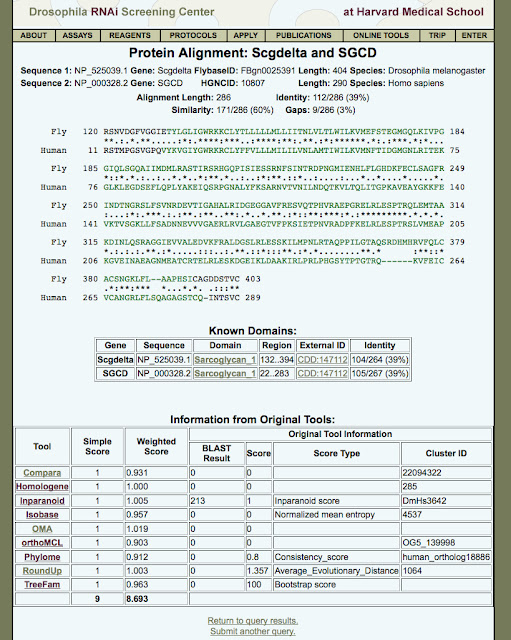
These reports utilize flies mutant for sarcoglycan (Sgcd), which the authors describe as a fly model of muscular dystrophy and cardiomyopathy. Fly Sgcd is related to human SGCD. 

Both papers are freely available.

Allikian MJ, Bhabha G, Dospoy P, Heydemann A, Ryder P, Earley JU, Wolf MJ, Rockman HA, McNally EM. Reduced life span with heart and muscle dysfunction in Drosophila sarcoglycan mutants. Hum Mol Genet. 2007 Dec 1;16(23):2933-43. PubMed PMID: 17855453.

Goldstein JA, Kelly SM, LoPresti PP, Heydemann A, Earley JU, Ferguson EL, Wolf MJ, McNally EM. SMAD signaling drives heart and muscle dysfunction in a Drosophila model of muscular dystrophy. Hum Mol Genet. 2011 Mar 1;20(5):894-904. PubMed PMID: 21138941; PubMed Central PMCID: PMC3033181.

Here's an alignment of fly Sgcd and human SGCD, as well as other info, from DIOPT (click "view" from DIOPT or the DIOPT score from DIOPT-DIST to reach this page).


Tuesday, August 7, 2012

Fly models of dilated cardiomyopathies. Recent review.

Wolf MJ. Modeling Dilated Cardiomyopathies in Drosophila. Trends Cardiovasc Med. 2012 Aug 2. PubMed PMID: 22863366.

The review includes a nice figure of the fly cardiovascular system (Fig. 2) and this statement in the Conclusions section:
Although the adult fly heart is a single cell layer thick and does not possess noncardiac cells found in mammalian hearts, the Drosophila model provides a system to examine the direct effects of gene mutations on size, morphology, and function of cardiomyocytes ... Ongoing investigations of the fly as a model for human cardiomyopathies have the potential to uncover new, fundamental mechanisms that are responsible for human cardiovascular diseases.