Jean S, Cox S, Schmidt EJ, Robinson FL, Kiger A. Sbf/MTMR13 coordinates PI(3)P and Rab21 regulation in endocytic control of cellular remodeling. Mol Biol Cell. 2012 Jul;23(14):2723-40. doi: 10.1091/mbc.E12-05-0375. PubMed PMID: 22648168; PubMed Central PMCID: PMC3395661.
Updated in 2019 to include this 2011 study from the same group:
Ribeiro I, Yuan L, Tanentzapf G, Dowling JJ, Kiger A. Phosphoinositide regulation of integrin trafficking required for muscle attachment and maintenance. PLoS Genet. 2011 Feb 10;7(2):e1001295. PMID: 21347281; PMCID: PMC3037412.
From the abstract: "Muscles must maintain cell compartmentalization when remodeled during development and use. How spatially restricted adhesions are regulated with muscle remodeling is largely unexplored. We show that the myotubularin (mtm) phosphoinositide phosphatase is required for integrin-mediated myofiber attachments in Drosophila melanogaster, and that mtm-depleted myofibers exhibit hallmarks of human XLMTM myopathy. ... Importantly, similar integrin localization defects found in human XLMTM myofibers signify conserved MTM1 function in muscle membrane trafficking. Our results indicate that regulation of distinct phosphoinositide pools plays a central role in maintaining cell compartmentalization and attachments during muscle remodeling, and they suggest involvement of Class II PI3-kinase in MTM-related disease.

Showing posts with label Myopathy. Show all posts
Showing posts with label Myopathy. Show all posts
Monday, April 8, 2019

Friday, December 16, 2016
Introduction of disease-associated mutations in Drosophila orthologs of genes linked to myopathy and muscular dystrophy
Li S, Zhang P, Freibaum BD, Kim NC, Kolaitis RM, Molliex A, Kanagaraj AP, Yabe I, Tanino M, Tanaka S, Sasaki H, Ross ED, Taylor JP, Kim HJ. Genetic interaction of hnRNPA2B1 and DNAJB6 in a Drosophila model of multisystem proteinopathy. Hum Mol Genet. 2016 Mar 1;25(5):936-50. PMID: 26744327; PMCID: PMC4754048.
From the abstract: "Adult-onset inherited myopathies with similar pathological features, including hereditary inclusion body myopathy (hIBM) and limb-girdle muscular dystrophy (LGMD), are a genetically heterogeneous group of muscle diseases. ... Here, we exploit a genetic model system to establish a mechanistic link between diseases caused by mutations in two distinct genes, hnRNPA2B1 and DNAJB6. Hrb98DE and mrj are the Drosophila melanogaster homologs of human hnRNPA2B1 and DNAJB6, respectively. We introduced disease-homologous mutations to Hrb98DE, thus capturing mutation-dependent phenotypes in a genetically tractable model system. ... These results indicate both genetic and physical interactions between disease-linked RBPs and DNAJB6/mrj, suggesting etiologic overlap between the pathogenesis of hIBM and LGMD initiated by mutations in hnRNPA2B1 and DNAJB6."
From the abstract: "Adult-onset inherited myopathies with similar pathological features, including hereditary inclusion body myopathy (hIBM) and limb-girdle muscular dystrophy (LGMD), are a genetically heterogeneous group of muscle diseases. ... Here, we exploit a genetic model system to establish a mechanistic link between diseases caused by mutations in two distinct genes, hnRNPA2B1 and DNAJB6. Hrb98DE and mrj are the Drosophila melanogaster homologs of human hnRNPA2B1 and DNAJB6, respectively. We introduced disease-homologous mutations to Hrb98DE, thus capturing mutation-dependent phenotypes in a genetically tractable model system. ... These results indicate both genetic and physical interactions between disease-linked RBPs and DNAJB6/mrj, suggesting etiologic overlap between the pathogenesis of hIBM and LGMD initiated by mutations in hnRNPA2B1 and DNAJB6."
Wednesday, July 3, 2013
New fly model: αB-crystallin-related cardiomyopathy. Recent report.
Xie HB, Cammarato A, Rajasekaran NS, Zhang H, Suggs JA, Lin HC, Bernstein SI, Benjamin IJ, Golic KG. The NADPH Metabolic Network Regulates Human αB-crystallin Cardiomyopathy and Reductive Stress in Drosophila melanogaster. PLoS Genet. 2013 PMID: 23818860.
Monday, June 10, 2013
New fly model: VCP mutation-dependent degeneration. Recent report.
Kim NC, Tresse E, Kolaitis RM, Molliex A, Thomas RE, Alami NH, Wang B, Joshi A, Smith RB, Ritson GP, Winborn BJ, Moore J, Lee JY, Yao TP, Pallanck L, Kundu M, Taylor JP. VCP is essential for mitochondrial quality control by PINK1/Parkin and this function is impaired by VCP mutations. Neuron. 2013 Apr 10;78(1):65-80. PMID: 23498974.
From the abstract: "Mutations in VCP cause multisystem degeneration impacting the nervous system, muscle, and/or bone. Patients may present with ALS, Parkinsonism, frontotemporal dementia, myopathy, Paget's disease, or a combination of these. The disease mechanism is unknown. We developed a Drosophila model of VCP mutation-dependent degeneration."
A related paper using human cells appears in the same issue of the journal. Bartolome et al. Pathogenic VCP mutations induce mitochondrial uncoupling and reduced ATP levels. Neuron. 2013 Apr 10;78(1):57-64. PMID: 23498975.
From the abstract: "Mutations in VCP cause multisystem degeneration impacting the nervous system, muscle, and/or bone. Patients may present with ALS, Parkinsonism, frontotemporal dementia, myopathy, Paget's disease, or a combination of these. The disease mechanism is unknown. We developed a Drosophila model of VCP mutation-dependent degeneration."
A related paper using human cells appears in the same issue of the journal. Bartolome et al. Pathogenic VCP mutations induce mitochondrial uncoupling and reduced ATP levels. Neuron. 2013 Apr 10;78(1):57-64. PMID: 23498975.
Tuesday, May 28, 2013
Screen in fly model of the myopathy Myotonic Dystrophy Type 1
This study related to Myotonic Dystrophy Type 1 crosses the bridge from fly screen (eye phenotype readout) to mammalian cell follow-up studies.
de Haro M, Al-Ramahi I, Jones KR, Holth JK, Timchenko LT, Botas J. Smaug/SAMD4A Restores Translational Activity of CUGBP1 and Suppresses CUG-Induced Myopathy. PLoS Genet. 2013 Apr;9(4):e1003445. PMID: 23637619; PMCID: PMC3630084.
de Haro M, Al-Ramahi I, Jones KR, Holth JK, Timchenko LT, Botas J. Smaug/SAMD4A Restores Translational Activity of CUGBP1 and Suppresses CUG-Induced Myopathy. PLoS Genet. 2013 Apr;9(4):e1003445. PMID: 23637619; PMCID: PMC3630084.
Friday, April 12, 2013
New Fly Model of Myotonic Dystrophy. Recent Report.
Picchio L, Plantie E, Renaud Y, Poovthumkadavil P, Jagla K. Novel Drosophila model of myotonic dystrophy type 1: phenotypic characterization and genome-wide view of altered gene expression. Hum Mol Genet. 2013 Apr 3. PubMed PMID: 23525904.
From the abstract: "we found the calcium pump dSERCA as a Mbl splice target and show that the membrane dSERCA isoform is sufficient to rescue a DM1-induced hypercontraction phenotype in a Drosophila model."
From the abstract: "we found the calcium pump dSERCA as a Mbl splice target and show that the membrane dSERCA isoform is sufficient to rescue a DM1-induced hypercontraction phenotype in a Drosophila model."
Wednesday, January 9, 2013
Disease-associated mutations in Actin. New fly models. Recent report.
These authors report introducing six different mutant forms of actin associated with myopathies in humans into the fly indirect flight muscle, as well as characterization of the resulting phenotypes.
Sevdali M, Kumar V, Peckham M, Sparrow J. Human congenital myopathy actin mutants cause myopathy and alter Z-disc structure in Drosophila flight muscle. Neuromuscul Disord. 2013 Jan 4. doi:pii: S0960-8966(12)00698-0. 10.1016/j.nmd.2012.11.013. PMID: 23294764.
Sevdali M, Kumar V, Peckham M, Sparrow J. Human congenital myopathy actin mutants cause myopathy and alter Z-disc structure in Drosophila flight muscle. Neuromuscul Disord. 2013 Jan 4. doi:pii: S0960-8966(12)00698-0. 10.1016/j.nmd.2012.11.013. PMID: 23294764.
Thursday, October 4, 2012
Fly model of muscular dystrophy and cardiomyopathy.
These reports utilize flies mutant for sarcoglycan (Sgcd), which the authors describe as a fly model of muscular dystrophy and cardiomyopathy. Fly Sgcd is related to human SGCD.
Both papers are freely available.
Allikian MJ, Bhabha G, Dospoy P, Heydemann A, Ryder P, Earley JU, Wolf MJ, Rockman HA, McNally EM. Reduced life span with heart and muscle dysfunction in Drosophila sarcoglycan mutants. Hum Mol Genet. 2007 Dec 1;16(23):2933-43. PubMed PMID: 17855453.
Goldstein JA, Kelly SM, LoPresti PP, Heydemann A, Earley JU, Ferguson EL, Wolf MJ, McNally EM. SMAD signaling drives heart and muscle dysfunction in a Drosophila model of muscular dystrophy. Hum Mol Genet. 2011 Mar 1;20(5):894-904. PubMed PMID: 21138941; PubMed Central PMCID: PMC3033181.
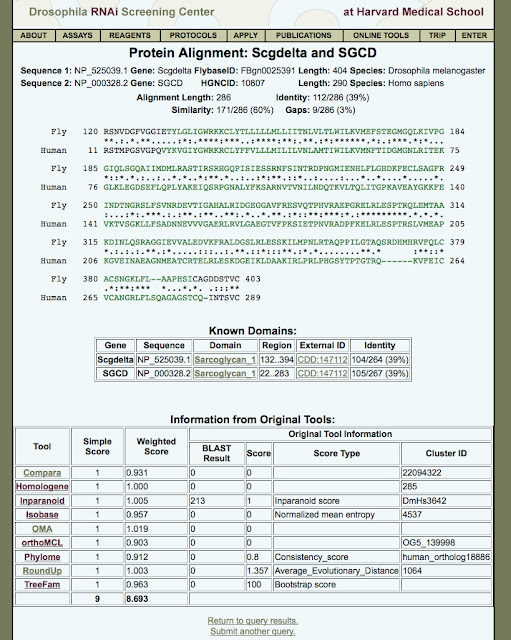
Here's an alignment of fly Sgcd and human SGCD, as well as other info, from DIOPT (click "view" from DIOPT or the DIOPT score from DIOPT-DIST to reach this page).
Both papers are freely available.
Allikian MJ, Bhabha G, Dospoy P, Heydemann A, Ryder P, Earley JU, Wolf MJ, Rockman HA, McNally EM. Reduced life span with heart and muscle dysfunction in Drosophila sarcoglycan mutants. Hum Mol Genet. 2007 Dec 1;16(23):2933-43. PubMed PMID: 17855453.
Goldstein JA, Kelly SM, LoPresti PP, Heydemann A, Earley JU, Ferguson EL, Wolf MJ, McNally EM. SMAD signaling drives heart and muscle dysfunction in a Drosophila model of muscular dystrophy. Hum Mol Genet. 2011 Mar 1;20(5):894-904. PubMed PMID: 21138941; PubMed Central PMCID: PMC3033181.
Here's an alignment of fly Sgcd and human SGCD, as well as other info, from DIOPT (click "view" from DIOPT or the DIOPT score from DIOPT-DIST to reach this page).
Friday, September 28, 2012
SMBA & Poly-Q study. Recent report.
Jochum T, Ritz ME, Schuster C, Funderburk SF, Jehle K, Schmitz K, Brinkmann F, Hirtz M, Moss D, Cato AC. Toxic and non-toxic aggregates from the SBMA and normal forms of androgen receptor have distinct oligomeric structures. Biochim Biophys Acta. 2012 Jun;1822(6):1070-8. PubMed PMID: 22366762.
The authors indicate that they used two existing fly stocks, pUAST-ARQ22 and pUAST-ARQ22dm, and generated two new transgenic stocks, pUAST-ARQ1 and -ARQ65, for the study. These are pathogenic forms of the human androgen receptor protein. See this FlyBase page for more info on human AR transgenic flies. To induce expression of the AR forms, these authors used the OK371-GAL4 driver fly stock.
The authors indicate that they used two existing fly stocks, pUAST-ARQ22 and pUAST-ARQ22dm, and generated two new transgenic stocks, pUAST-ARQ1 and -ARQ65, for the study. These are pathogenic forms of the human androgen receptor protein. See this FlyBase page for more info on human AR transgenic flies. To induce expression of the AR forms, these authors used the OK371-GAL4 driver fly stock.
Tuesday, September 25, 2012
New fly model of Inclusion Body Myopathy 3. Recent report.
This study describes a new fly model based on introduction of a human disease-associated missense mutation (E706K) in myosin heavy chain IIa. The mutant form was introduced via P-element transformation and crossed into an Mhc null mutant background.
Wang Y, Melkani GC, Suggs JA, Melkani A, Kronert WA, Cammarato A, Bernstein SI. Expression of the inclusion body myopathy 3 mutation in Drosophila depresses myosin function and stability and recapitulates muscle inclusions and weakness. Mol Biol Cell. 2012 Jun;23(11):2057-65. Epub 2012 Apr 11. PubMed PMID: 22496423; PubMed Central PMCID: PMC3364171.
Wang Y, Melkani GC, Suggs JA, Melkani A, Kronert WA, Cammarato A, Bernstein SI. Expression of the inclusion body myopathy 3 mutation in Drosophila depresses myosin function and stability and recapitulates muscle inclusions and weakness. Mol Biol Cell. 2012 Jun;23(11):2057-65. Epub 2012 Apr 11. PubMed PMID: 22496423; PubMed Central PMCID: PMC3364171.
Tuesday, August 7, 2012
Fly models of dilated cardiomyopathies. Recent review.
Wolf MJ. Modeling Dilated Cardiomyopathies in Drosophila. Trends Cardiovasc Med. 2012 Aug 2. PubMed PMID: 22863366.
The review includes a nice figure of the fly cardiovascular system (Fig. 2) and this statement in the Conclusions section:
The review includes a nice figure of the fly cardiovascular system (Fig. 2) and this statement in the Conclusions section:
Although the adult fly heart is a single cell layer thick and does not possess noncardiac cells found in mammalian hearts, the Drosophila model provides a system to examine the direct effects of gene mutations on size, morphology, and function of cardiomyocytes ... Ongoing investigations of the fly as a model for human cardiomyopathies have the potential to uncover new, fundamental mechanisms that are responsible for human cardiovascular diseases.
Subscribe to:
Posts (Atom)