Showing posts with label Muscular dystrophy. Show all posts

Friday, January 29, 2021

Fly model leads to new model for cellular mechanisms underlying diseases associated with disruption of Valosin-Containing Proteins

Nat Commun. 2021 Jan 21;12(1):513. doi: 10.1038/s41467-020-20796-8.

SVIP is a molecular determinant of lysosomal dynamic stability, neurodegeneration and lifespan.


Johnson AE, Orr BO, Fetter RD, Moughamian AJ, Primeaux LA,
Geier EG, Yokoyama JS, Miller BL, Davis GW
 

From the abstract:

Missense mutations in Valosin-Containing Protein (VCP) are linked to diverse degenerative diseases including IBMPFD, amyotrophic lateral sclerosis (ALS), muscular dystrophy and Parkinson's disease. Here, we characterize a VCP-binding co-factor (SVIP) that specifically recruits VCP to lysosomes. ... We also establish multiple links between SVIP and VCP-dependent disease in our Drosophila model system. ... Finally, we identify a human SVIP mutation and confirm the pathogenicity of this mutation in our Drosophila model. We propose a model for VCP disease based on the differential, co-factor-dependent recruitment of VCP to intracellular organelles.

DOI: 10.1038/s41467-020-20796-8
PMID: 33479240

Wondering what's IBMPFD? Answer: Inclusion body myopathy with early-onset Paget disease and frontotemporal dementia.

Friday, December 16, 2016

Introduction of disease-associated mutations in Drosophila orthologs of genes linked to myopathy and muscular dystrophy

Li S, Zhang P, Freibaum BD, Kim NC, Kolaitis RM, Molliex A, Kanagaraj AP, Yabe I, Tanino M, Tanaka S, Sasaki H, Ross ED, Taylor JP, Kim HJ. Genetic interaction of hnRNPA2B1 and DNAJB6 in a Drosophila model of multisystem proteinopathy. Hum Mol Genet. 2016 Mar 1;25(5):936-50. PMID: 26744327; PMCID: PMC4754048.

From the abstract: "Adult-onset inherited myopathies with similar pathological features, including hereditary inclusion body myopathy (hIBM) and limb-girdle muscular dystrophy (LGMD), are a genetically heterogeneous group of muscle diseases. ... Here, we exploit a genetic model system to establish a mechanistic link between diseases caused by mutations in two distinct genes, hnRNPA2B1 and DNAJB6. Hrb98DE and mrj are the Drosophila melanogaster homologs of human hnRNPA2B1 and DNAJB6, respectively. We introduced disease-homologous mutations to Hrb98DE, thus capturing mutation-dependent phenotypes in a genetically tractable model system. ... These results indicate both genetic and physical interactions between disease-linked RBPs and DNAJB6/mrj, suggesting etiologic overlap between the pathogenesis of hIBM and LGMD initiated by mutations in hnRNPA2B1 and DNAJB6."

Thursday, December 15, 2016

Review highlights role of zebrafish and Drosophila studies in understanding muscular dystrophies

Plantié E, Migocka-Patrzałek M, Daczewska M, Jagla K. Model organisms in the fight against muscular dystrophy: lessons from drosophila and Zebrafish. Molecules. 2015 Apr 9;20(4):6237-53. PMID: 25859781.

From the abstract: "Muscular dystrophies (MD) are a heterogeneous group of genetic disorders that cause muscle weakness, abnormal contractions and muscle wasting, often leading to premature death. More than 30 types of MD have been described so far; those most thoroughly studied are Duchenne muscular dystrophy (DMD), myotonic dystrophy type 1 (DM1) and congenital MDs. ... To improve our knowledge of how MD-caused muscle defects arise and to find efficacious therapeutic treatments, different animal models have been generated and applied. Among these, simple non-mammalian Drosophila and zebrafish models have proved most useful. This review discusses how zebrafish and Drosophila MD have helped to identify genetic determinants of MDs and design innovative therapeutic strategies with a special focus on DMD, DM1 and congenital MDs."

Wednesday, October 26, 2016

Fly, mouse, and human cell models of Duchenne muscular dystrophy used to evaluate exon skipping as a potential therapeutic strategy

Gao QQ, Wyatt E, Goldstein JA, LoPresti P, Castillo LM, Gazda A, Petrossian N, Earley JU, Hadhazy M, Barefield DY, Demonbreun AR, Bönnemann C, Wolf M, McNally EM. Reengineering a transmembrane protein to treat muscular dystrophy using exon skipping. J Clin Invest. 2015 Nov 2;125(11):4186-95. PMID: 26457733; PMCID: PMC4639981.

From the abstract: "Exon skipping uses antisense oligonucleotides as a treatment for genetic diseases. ... Exon skipping is currently being tested in humans with dystrophin gene mutations who have Duchenne muscular dystrophy. ... We generated an internally truncated γ-sarcoglycan protein that we have termed Mini-Gamma by deleting a large portion of the extracellular domain. Mini-Gamma provided functional and pathological benefits to correct the loss of γ-sarcoglycan in a Drosophila model, in heterologous cell expression studies, and in transgenic mice lacking γ-sarcoglycan. We generated a cellular model of human muscle disease and showed that multiple exon skipping could be induced in RNA that encodes a mutant human γ-sarcoglycan. Since Mini-Gamma represents removal of 4 of the 7 coding exons in γ-sarcoglycan, this approach provides a viable strategy to treat the majority of patients with γ-sarcoglycan gene mutations."

Monday, February 15, 2016

Tests in fly help shed light on mechanisms relevant to muscular dystrophy

Dialynas G, Shrestha OK, Ponce JM, Zwerger M, Thiemann DA, Young GH, Moore SA, Yu L, Lammerding J, Wallrath LL. Myopathic lamin mutations cause reductive stress and activate the nrf2/keap-1 pathway. PLoS Genet. 2015 May 21;11(5):e1005231. PMID: 25996830; PMCID: PMC4440730.

From the abstract: "Mutations in the human LMNA gene cause muscular dystrophy by mechanisms that are incompletely understood. The LMNA gene encodes A-type lamins, intermediate filaments that form a network underlying the inner nuclear membrane, providing structural support for the nucleus and organizing the genome. To better understand the pathogenesis caused by mutant lamins, we performed a structural and functional analysis on LMNA missense mutations identified in muscular dystrophy patients. These mutations perturb the tertiary structure of the conserved A-type lamin Ig-fold domain. To identify the effects of these structural perturbations on lamin function, we modeled these mutations in Drosophila Lamin C and expressed the mutant lamins in muscle. ... Affected muscles had cytoplasmic aggregation of lamins and additional nuclear envelope proteins. Transcription profiling revealed upregulation of many Nrf2 target genes. ... Elevated p62/SQSTM1 and nuclear enrichment of Nrf2 were identified in muscle biopsies from the corresponding muscular dystrophy patients, validating the disease relevance of our Drosophila model. Thus, novel connections were made between mutant lamins and the Nrf2 signaling pathway, suggesting new avenues of therapeutic intervention that include regulation of protein folding and metabolism, as well as maintenance of redox homoeostasis."

Monday, June 22, 2015

New fly model related to myotonic dystrophy type 1 (DM1)

Bargiela A, Cerro-Herreros E, Fernandez-Costa JM, Vilchez JJ, Llamusi B, Artero R. Increased autophagy and apoptosis contribute to muscle atrophy in a myotonic dystrophy type 1 Drosophila model. Dis Model Mech. 2015 Jul 1;8(7):679-90. PMID: 26092529.

From the abstract: "Muscle mass wasting is one of the most debilitating symptoms of myotonic dystrophy type 1 (DM1) disease, ultimately leading to immobility, respiratory defects, dysarthria, dysphagia and death in advanced stages of the disease. In order to study the molecular mechanisms leading to the degenerative loss of adult muscle tissue in DM1, we generated an inducible Drosophila model of expanded CTG trinucleotide repeat toxicity that resembles an adult-onset form of the disease. ... results were validated in skeletal muscle biopsies from DM1 patients ... and also in DM1 myoblasts ... These findings provide new insights into the signaling pathways involved in DM1 disease pathogenesis."

Friday, April 17, 2015

Review highlights fly research contributions to understanding muscular dystrophies

Plantié E, Migocka-Patrzałek M, Daczewska M, Jagla K. Model Organisms in the Fight against Muscular Dystrophy: Lessons from Drosophila and Zebrafish. Molecules. 2015 Apr 9;20(4):6237-6253. PMID: 25859781.

Table 1 from Plantie et al. Click to view the Open Access review.
From the abstract: "Muscular dystrophies (MD) are a heterogeneous group of genetic disorders that cause muscle weakness, abnormal contractions and muscle wasting, often leading to premature death. ... Structurally, physiologically and biochemically, MDs affect different types of muscles and cause individual symptoms such that genetic and molecular pathways underlying their pathogenesis thus remain poorly understood. To improve our knowledge of how MD-caused muscle defects arise and to find efficacious therapeutic treatments, different animal models have been generated and applied. Among these, simple non-mammalian Drosophila and zebrafish models have proved most useful. This review discusses how zebrafish and Drosophila MD have helped to identify genetic determinants of MDs and design innovative therapeutic strategies with a special focus on DMD, DM1 and congenital MDs."

Tuesday, April 15, 2014

Review--animal models and Oculopharyngeal Muscular Dystrophy

Chartier A, Simonelig M. Animal models in therapeutic drug discovery for oculopharyngeal muscular dystrophy. Drug Discov Today Technol. 2013 Spring;10(1):e103-8. PMID: 24050237.

Friday, May 31, 2013

Recent report: Parallel work in mouse and fly related to facioscapulohumeral muscular dystrophy

Neguembor MV, Xynos A, Onorati MC, Caccia R, Bortolanza S, Godio C, Pistoni M, Corona DF, Schotta G, Gabellini D. FSHD muscular dystrophy region gene 1 binds Suv4-20h1 histone methyltransferase and impairs myogenesis. J Mol Cell Biol. 2013 May 29. PMID: 23720823.

Thursday, October 4, 2012

Fly model of muscular dystrophy and cardiomyopathy.

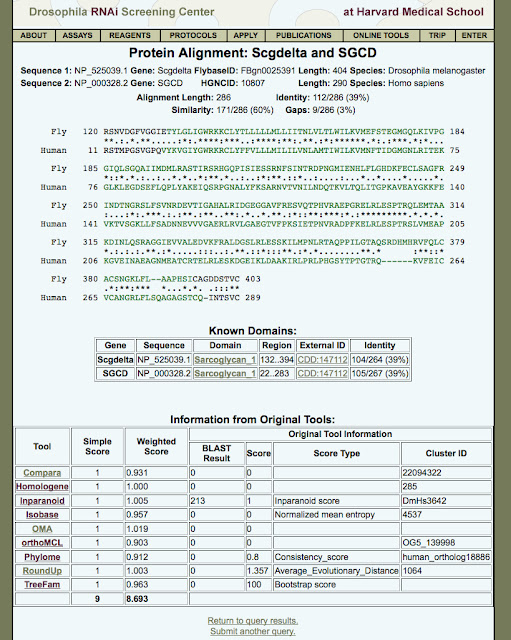
These reports utilize flies mutant for sarcoglycan (Sgcd), which the authors describe as a fly model of muscular dystrophy and cardiomyopathy. Fly Sgcd is related to human SGCD. 

Both papers are freely available.

Allikian MJ, Bhabha G, Dospoy P, Heydemann A, Ryder P, Earley JU, Wolf MJ, Rockman HA, McNally EM. Reduced life span with heart and muscle dysfunction in Drosophila sarcoglycan mutants. Hum Mol Genet. 2007 Dec 1;16(23):2933-43. PubMed PMID: 17855453.

Goldstein JA, Kelly SM, LoPresti PP, Heydemann A, Earley JU, Ferguson EL, Wolf MJ, McNally EM. SMAD signaling drives heart and muscle dysfunction in a Drosophila model of muscular dystrophy. Hum Mol Genet. 2011 Mar 1;20(5):894-904. PubMed PMID: 21138941; PubMed Central PMCID: PMC3033181.

Here's an alignment of fly Sgcd and human SGCD, as well as other info, from DIOPT (click "view" from DIOPT or the DIOPT score from DIOPT-DIST to reach this page).